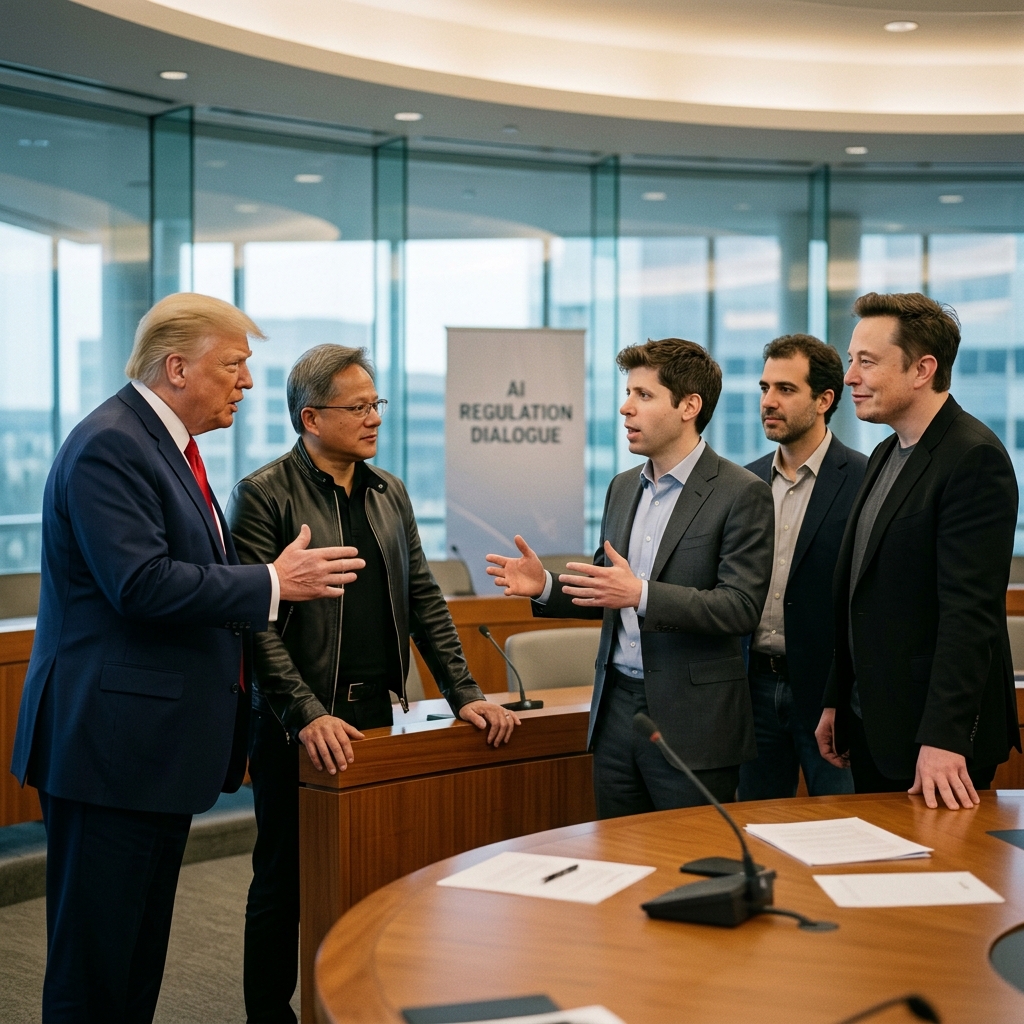
AI Pause? Why Do AI CEOs Call for Regulation While Others Don’t?

[posts_like_dislike]
Page Contents
Topics

Relevant Topics:

All Topics
More On This Topic

AI parrots EV misinformation: Regen Myths and “Only charges the battery”.

I have another more general video on the main channel on the far greater dangers of AI parroting misinformation, but this video focuses on three specific questions related to EVs where the web can contain at least as many copies of the wrong answer as the right answer and that leads to AI just rehashing the wrong answer.

Welcome to One Finite Planet, a channel on our journey to a new age, today focusing on how AI can amplify and perpetuate misinformation. First the principle, then three examples. Two on how regen works, or in fact doesn’t work, and another on “the generator is only used to charge the battery myth.”

Read More »

Purpose/Mission/Vision: AI Makes Defining Our Purpose Imperative: Custodianship and Prosperity of complex intelligent life of Earth?

Do we need a purpose? If so, why not simply “custodians of life”? How we’re not the real threat and this mission does require us? and the role of AI — these are key questions i feel are in need of being addressed.

Welcome to One Finite Planet, a channel on our journey to a new age, today questioning whether AI increases the need for a unifying purpose.

Read More »

AI + Self-Driving Car Sensors Explained: LIDAR vs Radar, Cameras & Ultrasonic.

From the youtube description: Self-driving cars rely on more than just hype — they need sensors that can actually “see” the road. In this video, we break down the four key sensor types: LIDAR, radar, cameras, and sonar. You’ll learn the pros and cons of each technology, the myths surrounding LIDAR, and how these sensors shape the future of AI, robotics, and autonomous vehicles.

Whether you’re curious about Tesla’s approach, Waymo’s choices, or the broader race toward full autonomy, this guide gives you the foundation to understand what’s really going on behind the buzzwords.

Read More »

AI & Robots: The Class Revolution That Will Change Everything

This is just the introduction, and a series of pages/videos will follow on will AI & robots exterminate us, updates on technical progress and breakthroughs, and on how, whether, as technology as done in past, AI & Robots, driven increases productivity will result in more jobs becoming viable.

But this page/video prefixes those points with a look at the long term goal: where are we heading, and concludes and we are headed for a revolution with who benefits from that revolution not yet clear.

Read More »

Robot types and technologies: AI universal robots change everything.

As robots have been around since the 1950s, and humanoid robots have existed in science fiction over a century, it can easily be overlooked how AI humanoid robots could change our entire society and economic system when previous robots, which can be considered as specialist robots, didn’t have that much impact.

This is a look at the types of robots and technologies behind the changes.

Read More »

AI & AI Robots: 3 steps to “we aren’t ready!”

If leading experts are correct, AI robots are coming and will take our jobs, so how will we afford robots to make our lives better?

So far, there have been 3 steps, to understanding what is coming: 1) Seeing how already in 2024 AI and Robots have already reached a tipping point, 2) Reading what the experts say before dismissing the threat to jobs and assuming that new jobs will be created as they have in the past, 3) Understanding that Univeral Basic Income (UBI) won’t be enough.

Elon Musk and others currently propose a form of Univeral Basic Income UBI as the future, but the future for people like Elon Musk who work on and profit from the AI and Robots seems much clearer than for those who made redundant. How does Elon Musk asking for remuneration valued at $55 billion while Tesla is laying off over 10% of staff consistent with a world where everyone enjoys wealth through AI?

If this AI and robot future is real, then the entire capitalist system needs at least serious revision, and the solution may come from everyone owning robots.

Read More »
All Topics

Page Contents

AI regulation, an AI pause, and AI safety are increasingly being debated — but why are AI CEOs Sam Altman, Dario Amodei and Elon Musk calling for restrictions on their own industry, while Trump, Huang and others argue AI can self-regulate?

AI Pause? Why Do AI CEOs Call for Regulation While Others Don’t?

AI regulation, an AI pause, and AI safety are increasingly being debated — but why are AI CEOs Sam Altman, Dario Amodei and Elon Musk calling for restrictions on their own industry, while Trump, Huang and others argue AI can self-regulate?

This video looks at the very different incentives and concerns behind those positions. The motives of AI CEOs can reasonably be questioned — but calls for stronger oversight are not coming from them alone. Prominent AI researchers and former insiders including Geoffrey Hinton, Yoshua Bengio and Ilya Sutskever have also raised serious concerns.

That doesn’t mean every call for regulation has the same motivation. AI companies face competitive pressure, shareholder obligations and the risk that unilateral safety measures simply hand an advantage to competitors willing to take greater risks.

The deeper question may therefore be whether AI can safely remain primarily a private competitive asset at all — or whether increasingly powerful AI ultimately needs some form of international framework and a mission extending beyond shareholder profit.

AI pause? AI regulation? Self-regulation? Or a fundamentally different model for governing AI?

#AI #AIRegulation #AISafety #ArtificialIntelligence #AIGovernance

AI regulation, AI pause, AI safety, AI governance, artificial intelligence, AI self regulation, Sam Altman, Dario Amodei, Elon Musk, Donald Trump, Jensen Huang, Geoffrey Hinton, Yoshua Bengio, Ilya Sutskever, AI CEOs, AI risks, AI oversight, AI policy, AI regulation debate, artificial intelligence regulation, AI safety debate, AI industry, AI companies, AI competition, AI existential risk, AI alignment, future of AI, global AI governance, regulating AI, should AI be regulated, pause AI, AI development, AI race, AI control

With President Trump and Nvidia CEO Jensen Huang both saying AI can self-regulate, it’s easy to dismiss calls by AI CEOs Altman, Amodei and Musk as unrealistic ploy to drive up, investor interest in the power of AI.

But then you have those who quit, claiming to fear the risks. What’s in it for them?

Jacob Coxon, who kicked off the recent debate, was just mid-level and new to Anthropic.

But he’d been at OpenAI three years and seemingly moved in search of better oversight but didn’t find it.

But his calls have been supported by far more senior people.

Some still there, but others like Joe Benton, former senior manager of an oversight team, said they also left over safety concerns.

Godfather of AI, Geoffrey Hinton, left his position at Google in 2023 to speak freely about the potential risks of AI.

Since then, he’s shared several key perspectives on AI safety.

There’s also Yoshua Bengio, considered another godfather of AI.

Ilya Sutskever, former chief scientist at OpenAI, I could go on.

Neither I, nor anyone listening can really feel that they’re better to judge the risks, than this list. And they’re concerned. Those CEOs, they’re not all the same and they may have different mixes of reasons.

But without outside regulation, they have a fiduciary duty to maximise value for their shareholders.

Plus, self-regulation is pointless, if a competitor without the same safeguards could both gain dominance and expose the world to the dangers you’re taking steps to prevent.

Their calls for regulation may be pointless, and without trusted international cooperation, go nowhere. Maybe all they want is to try and keep those altruistic employees onside.

But this is clearly a serious issue.

My own view, and I’m far from alone, and it includes at least several of those mentioned as AI founders, is that AI needs to be a global public asset and needs to have a clear mission other than shareholder profit.

We widely view capitalism as the best system there is, but also with good reason, not one country runs everything under capitalism or for profit.

Capitalism may be best as a system, but it’s not best for everything!

Consider:

  • Public Libraries.
  • Fire Brigades.
  • Police.
  • The Justice system.
  • …
  • Public Land!
From on screen in video

If you were to calculate the total value of all public land ( including that not normally counted, like sidewalks/footpaths ), it would dwarf the global total stock market value.

Simple example, we don’t pay fees to companies owning all the footpaths and sidewalks, but instead have a concept of public land.

AI may end up needing to be in that same category. Something to consider. Interesting to hear your thoughts.

To add comments, please go to the video link at the top of the page and add comments to the the video.

For more on topic(s) covered, click the link(s) below.